
Guides · Winter jobs · Published November 20, 2026 · By Faizan Ahmad
How to Prevent Frost Heaving: Keep Perennials in the Ground All Winter
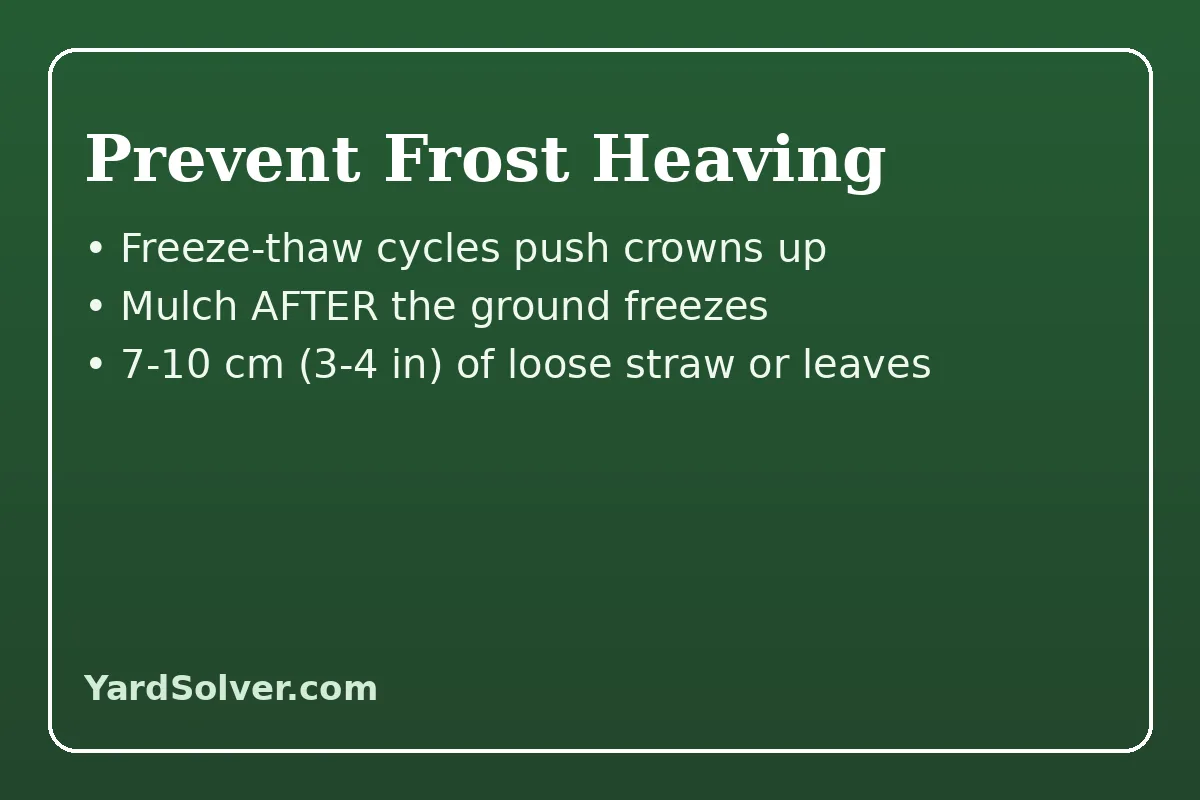
To prevent frost heaving, keep the soil frozen once it freezes: apply a loose 7–10 cm (3–4 in) layer of winter mulch — straw, shredded leaves, pine needles or evergreen boughs — only after the ground has frozen, concentrate on new fall plantings and shallow-crowned perennials, and fix drainage in beds that heave every year. Frost heaving is the slow ejection of a plant from its own bed: repeated freezing and thawing of the soil surface lifts the crown a few millimetres at a time, until by late winter the roots sit exposed above the soil line, drying in cold wind. It is one of the most common — and most preventable — causes of winter loss in perennial beds, strawberry patches and new plantings across Canada and the northern and central US. This guide explains the mechanism, names the plants that heave first, gives the exact mulch timing and depth the extension services agree on, and shows how to rescue a plant that has already been pushed up.
The short answer, on one card
The cause: freeze–thaw cycles in bare, wet soil — not deep cold itself. The fix: mulch after the ground freezes, not before, so the soil stays frozen and stable all winter. The depth: 7–10 cm (3–4 in) of loose material over the crown for susceptible perennials; a little more for tender ones. The priority list: anything planted this fall, plus coral bells, shasta daisies, mums, strawberries and other shallow-crowned plants. The rescue: on a mild, thawed day, press the plant back, firm soil around the exposed roots, water it in and re-mulch. The long-term cure: better drainage — heaving is worst in wet, silty and clay soil that holds water at the surface.
What frost heaving actually is
Soil heaves because water expands as it freezes — by roughly 9 percent — and because ice lenses grow in the top layer of soil, drawing water up and pushing everything above them upward. One freeze lifts a plant slightly; the thaw lets soil slump into the gap underneath; the next freeze lifts it again from its new, higher position. The plant ratchets upward all winter without ever moving back down. University of Minnesota Extension describes the result plainly: alternating freezing and thawing in early winter and spring can cause plants to lift or heave out of the soil, which can destroy roots. The damage is rarely the lift itself — it is what the lift exposes. Roots and crowns that evolved to sit insulated underground end up in open air, where cold wind dries them and temperature swings hit them directly. A heaved plant often looks fine in February and dies in March. Hence the quotable rule of this guide: deep cold rarely kills a hardy perennial in winter — the freeze–thaw elevator does.
Three conditions make heaving worse, and most problem beds have at least two. First, bare soil: a bed with no snow cover, no mulch and no plant canopy takes the full force of every sunny-day thaw and clear-night freeze. Second, wet soil: moisture is the fuel, which is why low spots, downspout corners and heavy clay beds heave worst. Third, shallow roots: a plant set in the ground six weeks ago, or a species that naturally crowns at the surface, has nothing anchoring it against the lift. Snow, when it comes early and stays, is nature's own anti-heave blanket — the trouble is the winters, increasingly common, when it does not.
The plants that heave first
| Plant | Why it heaves | Protection that works |
|---|---|---|
| Coral bells (Heuchera) | Shallow, woody crown sits at the surface | Mulch around — not buried over — the crown after freeze; check monthly |
| Shasta daisy, mums | Fibrous, shallow root mass, late-season growth | 7–10 cm straw or shredded leaf mulch after the ground freezes |
| Strawberries | Crowns at soil level; unprotected plants suffer badly below about −7 °C (18 °F) | Straw or marsh hay 5–10 cm (2–4 in) deep once dormant and frozen |
| Foamflower, pincushion flower, sea thrift, bergenia | Named by Iowa State Extension as heave-prone | Loose mulch over the crown after freeze-up; leave foliage in place |
| Hen-and-chicks | Roots barely anchor; rosettes pop out whole | Gritty, drained soil plus a light pine-needle cover |
| Anything planted this fall | Root ball has not knitted into the surrounding soil | The full treatment: watered in before freeze, mulched after freeze, checked after thaws |
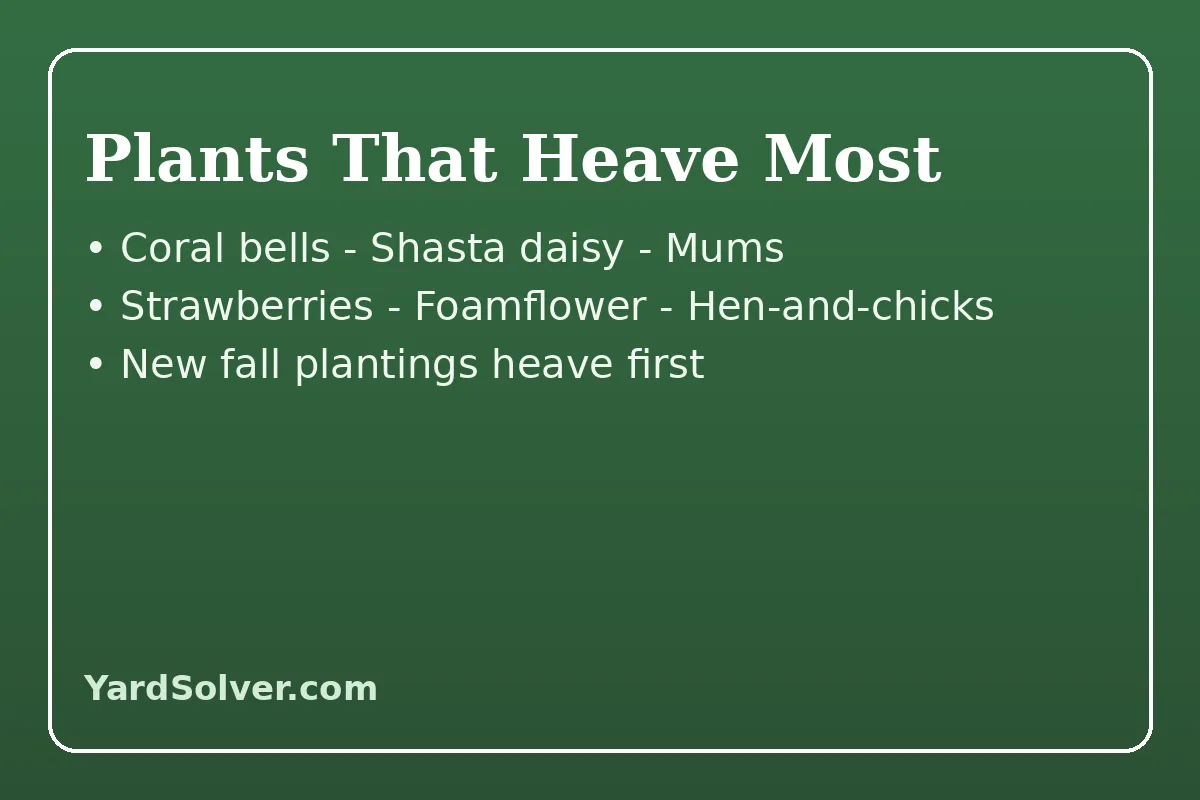
Iowa State University Extension's frost-heaving guidance lists coral bells, strawberries, mums, bergenia, pincushion flower, sea thrift, foamflower, shasta daisy and hen-and-chicks among the species most prone to heaving — a list worth taping inside the shed door, because it is almost exactly the list of plants gardeners find sitting on top of their beds in March. Established, deep-rooted perennials in drained soil — peonies, daylilies, hostas in a good bed — usually ride out the winter untouched. Spend your mulch and your checking time where the risk actually is.
The mulch-after-freeze rule, and why timing is everything
Winter mulch has one job, and it is not the job most people assume. It does not keep the ground from freezing — in a Canadian or northern-US winter the ground freezes regardless. Its job is to keep frozen ground frozen: to shade the surface from winter sun and buffer the swings, so the soil thaws once, in spring, instead of twenty times between December and March. That is why every extension service gives the same timing instruction. The University of Minnesota Extension puts it in its title — mulch perennials and bulbs after the soil freezes — and warns that applying cover during fall cleanup, before the soil begins to freeze, can encourage growth beneath the mulch that weakens the plant. Iowa State adds the dormancy point: mulch applied too early can delay dormancy and increase the risk of winter injury, and it can also give voles a warm, early tenancy. UW–Madison Extension's guidance, via its Kenosha County winter-mulch notes, lands in the same place: apply as the ground is about to freeze, typically around late November in the upper Midwest, and remember that winter mulch prevents the freezing-and-thawing conditions that force roots and crowns out of the soil.
In practice: wait for several hard frosts and soil that is frozen at the surface — a crust you cannot easily push a trowel through in the morning. Then lay 7–10 cm (3–4 in) of loose material over the crowns of susceptible plants: clean straw, shredded leaves (whole leaves mat and smother), pine needles, or the evergreen boughs left over from winter containers. Keep the material loose and airy — it should insulate like a duvet, not seal like a lid — and for fleshy-crowned plants such as coral bells, tuck it around the crown rather than burying the centre, which invites rot. Tender perennials can take a deeper blanket, 15–20 cm (6–8 in), ideally inside a wire ring that holds it in place. Our mulch calculator guide works out volumes for a whole bed, and Types of Mulch compares materials if you are choosing what to buy or gather.
Rescuing a plant that has already heaved
Check susceptible beds after every serious thaw from January onward. A heaved plant sits visibly high, often tilted, with roots or the underside of the crown exposed and a gap beneath it. Do not stomp it back into frozen ground — that shears roots and compacts soil around them. Wait for a mild day when the surface soil has thawed enough to work, then press the plant gently back to its original depth, firm loose soil in around the exposed roots with your hands, and water it in if the soil is dry, so soil settles into every air pocket. Re-cover with mulch to stop the cycle repeating. If the plant has heaved completely out and the ground is still frozen hard, lay soil or compost over the exposed roots as a temporary blanket, mark the spot, and re-seat it properly at the first thaw. Plants caught early almost always recover; plants whose roots spent weeks drying in February wind usually do not, which is why the monthly walk matters more than any single rescue technique.
The long-term cure: drainage, planting dates and snow
If the same bed heaves every winter, mulch is treating the symptom. Work compost into heavy soil over a few seasons to open its structure, raise chronically wet beds, and move downspout discharge away from perennial plantings — the full soil programme is in Putting Your Garden to Bed. Plant perennials early enough in fall — six weeks before the ground freezes is the working rule — for roots to anchor, or hold late purchases in their pots using the methods in How to Overwinter Potted Perennials and plant them in spring instead. Leave healthy perennial stems and foliage standing through winter where the plant allows it: they trap snow over the crown, and trapped snow is the steadiest insulator of all. Where wind strips snow from an exposed bed, a temporary snow fence or a row of evergreen boughs on the windward side holds a protective drift in place. And where winter burn threatens the evergreens themselves, the companion guide How to Prevent Winter Burn on Evergreens covers the above-ground half of the same freeze–thaw problem. Add the monthly heave check to the December Garden Checklist rhythm and repeat it in January and February — five minutes with a bucket of soil and a mulch fork is the cheapest insurance a perennial bed can have.
Keep going
Catch the symptom early with the monthly checks above, size the job with How Much Mulch Do I Need?, protect the shrubs behind the bed with How to Prevent Winter Burn on Evergreens, hold late purchases safely with How to Overwinter Potted Perennials, and run the season from the December Garden Checklist.
Sources
The definition of frost heaving, the list of heave-prone species (coral bells, strawberries, mums, bergenia, pincushion flower, sea thrift, foamflower, shasta daisy, hen-and-chicks), the 3–4 inch mulch depth after the ground has frozen and the warning that early mulch delays dormancy follow Iowa State University Extension, What Is Frost Heaving, and How Do I Prevent It? The mulch-after-the-soil-freezes timing, the 5–6 inches of leaves or straw, and the warning against mulching during fall cleanup follow the University of Minnesota Extension, Mulch Perennials and Bulbs After the Soil Freezes. The explanation that winter mulch prevents freeze–thaw cycling rather than keeping soil warm, strawberry depths and late-fall timing follow UW–Madison Extension (Kenosha County), Winter Mulch Your Landscape Plants.
Questions people ask
What is frost heaving in a garden?
Frost heaving is the gradual lifting of a plant out of its bed by repeated freezing and thawing of the soil surface. Each freeze pushes the crown up slightly and the thaw never lets it settle fully back, so over a winter the roots end up exposed above the soil line, where cold wind dries and kills them.
How do I prevent frost heaving?
Apply a loose 7–10 cm (3–4 in) layer of winter mulch — straw, shredded leaves, pine needles or evergreen boughs — after the ground has frozen, so the soil stays frozen and stable instead of cycling. Concentrate on new fall plantings and shallow-crowned perennials, and improve drainage in beds that heave repeatedly.
When should winter mulch go on to stop heaving?
After the ground has frozen at the surface and plants are fully dormant — typically late November in much of Canada and the northern US. Mulch applied earlier, during fall cleanup, can delay dormancy, encourage weak growth under the cover and shelter voles, all of which increase winter injury.
Which plants are most likely to heave out of the ground?
Shallow-crowned and shallow-rooted plants: coral bells, shasta daisy, mums, strawberries, foamflower, pincushion flower, sea thrift, bergenia and hen-and-chicks, per Iowa State Extension — plus anything planted in fall that has not yet rooted into the surrounding soil.
Can a heaved plant be saved?
Usually, yes, if caught early. On a mild day when the surface soil has thawed, press the plant back to its original depth, firm soil around the exposed roots, water it in to close air pockets and re-mulch. Do not force a plant back into frozen ground, which shears roots.
Why does my garden heave in some winters and not others?
Heaving needs freeze–thaw cycles at the soil surface, which happen most in winters with little or late snow cover and frequent mild spells. A winter with early, deep, lasting snow insulates the ground naturally and heaving is rare; a bare, swingy winter is the dangerous one.
Comments & ratings
No comments yet.
Be the first to share your experience.