
Guides · Winter jobs · Published November 20, 2026 · By Faizan Ahmad
How to Protect Terracotta Pots in Winter So They Don't Crack
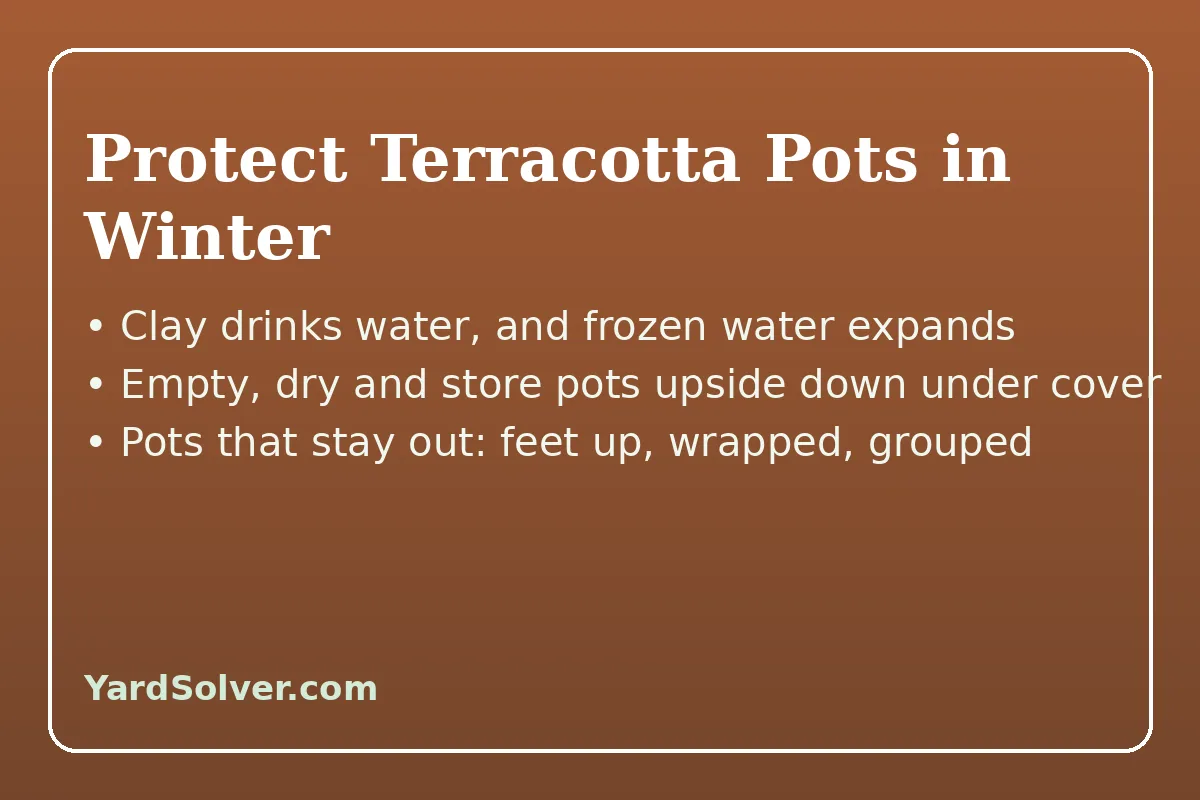
To protect terracotta pots in winter, empty them, scrub them clean, let them dry completely, and store them upside down in a dry, sheltered place — an unheated garage, shed, cold frame or basement; for planted pots that must stay outside, lift them onto pot feet, remove saucers, group them in shelter, and wrap the pots in bubble wrap or burlap under a waterproof cover, because unglazed clay absorbs water, and water trapped in the clay wall expands as it freezes and splits the pot. Terracotta's porosity is its summer virtue — it breathes, it keeps roots cool, it ages beautifully — and its winter fatal flaw, in every garden where temperatures cross freezing with water in the ground. One hard night rarely kills a pot; a season of freeze-thaw cycling, each thaw drawing more water into hairline pores and each freeze wedging them wider, is what reduces a good pot to shards and flakes by March. This guide explains the mechanism plainly, gives the storage method step by step, the protect-in-place method for pots with plants in them and pots too big to move, and the buying distinction — frost-proof versus frost-resistant — that decides the question at the garden centre. It sits alongside How to Overwinter Potted Perennials, which protects the plants; this one protects the pots themselves.
The short answer, on one card
The enemy is water, not cold: dry terracotta tolerates deep cold; wet terracotta cracks in an ordinary frost. Empty pots: clean, disinfect, dry for several days, store upside down under cover, stacked staggered with padding between rims. Planted pots: the plant's rules and the pot's rules both apply — feet up so it drains, saucer off, wrapped and sheltered, soil moist but never sodden. Oversized pots: empty if humanly possible; flip and tarp, or lay on the side so water cannot pool. Materials: the same caution covers ceramic and glazed pottery — Penn State Extension advises against leaving any of them exposed to winter weather. Spring: uncover gradually and bring stored pots out once the wild freeze-thaw swings settle.
Why clay cracks: the sponge that freezes from inside
Unglazed terracotta is fired clay with its pores open. All season it drinks — from the soil inside, from rain, from standing in a saucer — and by November a pot left outdoors is holding water throughout its wall. Water is nearly unique among liquids in expanding as it solidifies, by roughly a tenth of its volume, and ice forming inside a confined pore exerts pressure no clay body can argue with. The first freezes open microscopic fissures; the fissures admit more water at the next thaw; by mid-winter the wall begins to spall — flakes and sheets of surface clay popping away — or splits outright along a freeze line. Colorado State Extension's summary, carried in container-winter guidance, names the same trigger from the soil side: many containers, especially porous ones, crack when moist potting mix freezes and thaws repeatedly through the winter. Brooklyn Botanic Garden's overwintering guidance is blunt about the conclusion: most terracotta is not suitable for leaving outside in freezing temperatures. Hence the quotable rule of this guide: a terracotta pot does not die of cold — it dies of being wet when the cold arrives, so every winter method below is, at bottom, a way of keeping clay dry. That single idea also explains the exceptions gardeners report: the pot that survived ten winters stood under an eave, bone dry; the pot that died in one stood in the open, full of wet soil, in a saucer of ice.
Empty pots: the clean, dry, upside-down method
| Step | How | Why it matters |
|---|---|---|
| 1. Empty | Tip out soil and spent plants; save good mix separately | Wet soil inside is the largest water reservoir the pot has |
| 2. Scrub | Brush off soil and algae; wash in 1 part bleach to 10 parts water; rinse well | Removes disease and pests that would overwinter in the clay's pores |
| 3. Dry | Several days in open air and sun, until the clay is pale and light | Storing a damp pot stores the very water that cracks it |
| 4. Store | Upside down, under cover, off bare ground | Nothing can pool in an inverted pot; cover keeps winter wet off |
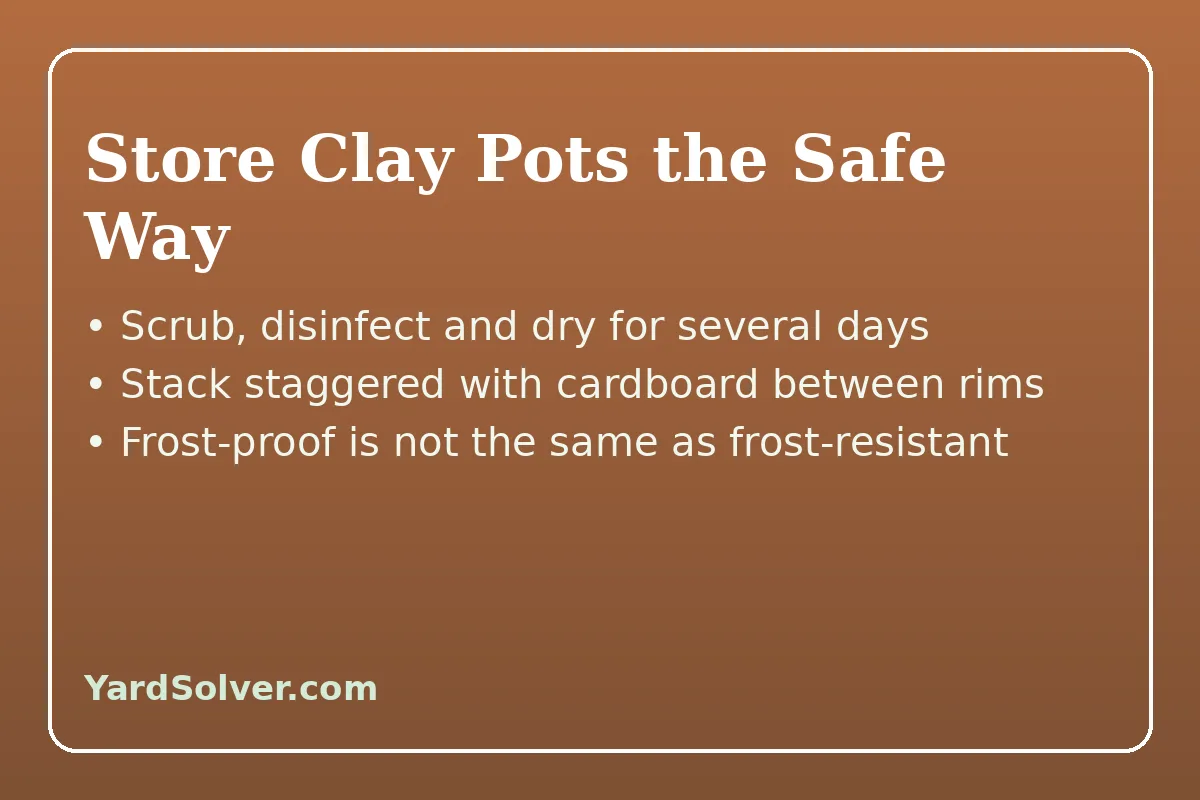
| 5. Stack smart | Stagger sizes; cardboard or cloth between nested rims | Tight-nested pots chip, wedge and trap moisture between walls |
HGTV's long-standing pot-care guidance runs this exact sequence — remove the plants, dump the soil, scrub with the one-to-ten bleach solution, rinse, dry thoroughly in air and sun, then stack upside down somewhere dry — and adds the two refinements experience teaches. First, avoid tight nesting: stagger the stack so air circulates between pots and rims are not grinding on each other; a sheet of cardboard or an old towel between sizes prevents the chipped rims that tight stacking causes. Second, for pots too big to bring in at all, the fallback is to turn them upside down and cover them with a waterproof tarp, or — if too heavy to flip — wrap them and lay them on their sides, raised off the wet ground, so rain and snow cannot accumulate inside. Note where storage happens on Penn State Extension's list: an unheated garage, shed, cold frame or basement — the pot does not need warmth, it needs dryness and shelter from the wettest freeze-thaw exposure, which is why a covered porch stack outperforms a heated but steamy greenhouse corner. Do the job on the same round as Putting Your Garden to Bed, while the soil is still workable and before the first pot-freezing night, not after it.
Planted pots that must stay outside
Sometimes the pot and plant travel together — a hardy shrub, a potted perennial following the overwintering method, an evergreen by the door. Then protect both at once, using Penn State Extension's container framework, which was written for exactly this case. Start with position: group the pots together in the most sheltered spot you have — against a wall, under an eave — because clustered pots insulate each other and a wall sheds both wind and driving rain. Raise every pot on feet, bricks or wood blocks: a pot sitting flat on frozen ground wicks ground moisture into its base all winter and can freeze fast to the earth, so that moving it later tears clay away in chunks. Take saucers off entirely; a saucer in winter is an ice mould pressed against the pot's base. Wrap the pot — not the plant — in bubble wrap or burlap, then add a waterproof outer layer such as plastic or a tarp skirt, exactly as Penn State prescribes for clay, ceramic and glazed pots that must stay out; the insulation slows the freeze-thaw cycling of the wall, and the waterproofing stops the wrap itself becoming a wet sponge against the clay. Water discipline cuts the other way from instinct: the plant's soil should go into winter moist, because dry soil freezes faster and offers roots no buffer, and it should be checked during thaws — but never leave the pot standing in meltwater, and never water on the eve of a hard freeze. Penn State's alternatives belong in the same toolkit for smaller pots: bury the whole pot in a spare bed up to its rim and mulch over it, converting the container back into ground, or set the pot inside a larger container or box packed with straw, shredded leaves or bark mulch. In spring, whichever method you used, remove covers gradually so plant and pot both re-acclimatise instead of meeting a warm week and a killing night unprepared.
Frost-proof, frost-resistant, and other label honesty
Two phrases at the garden centre decide more winter outcomes than any technique in this guide, and they do not mean the same thing. Frost-resistant terracotta is standard clay with a suggestion: it resists light frost, in a mild winter, kept reasonably dry — in a Canadian or northern-US winter left outdoors it is a pot on borrowed time. Frost-proof (sometimes sold as frost-hardy) pots are fired hotter and denser, often thicker-walled, and are made and warranted to survive freezing — the only terracotta that should be bought for permanent outdoor planting in cold zones, and even then the feet-up, saucer-off, free-draining rules apply, because no clay is proof against standing in ice. Read the label for the actual guarantee rather than the adjective, and be honest about the arithmetic: a cheap standard pot replaced every second spring costs more across a decade than one frost-proof pot, before counting the plant lost the year the cheap one split in January. The material table in Types of Mulch has its container counterpart here — wood, fibreglass, quality plastic, metal and thick concrete shrug off winters that kill clay, which is why the permanent bones of a cold-climate patio are usually those materials, with terracotta brought out as the summer dressing it is happiest being. And when a pot does crack: a clean two-piece break on a beloved pot can be wired or glued for ornamental duty, a spalling wall cannot — retire it to crocks, where its drainage career continues honourably at the bottom of its successors.
The November pot round, in order
Pull the whole job into one circuit before the ground freezes. First, the tender plants come in — How to Bring Plants Indoors for Winter has that sequence — which empties most summer terracotta in a single pass. Second, empty, scrub and dry those pots while a mild spell lasts; drying is the step that cannot be hurried in December. Third, walk the planted pots that stay out: feet, saucers off, grouped, wrapped, watered once well before the soil freezes. Fourth, deal with the giants — flipped and tarped, or sided and covered — while help and daylight are available. Fifth, store the dried empties upside down and staggered, and write the count in the journal from How to Start a Garden Journal, because the gardener who knows she owns fourteen good pots buys none in the April sales, and the one who lost three to a wet November knows exactly which shelf of the shed failed her. Fifteen pots protected in an hour in November is the cheapest insurance in the garden: the alternative is buying the same pots again in spring, at spring prices, while sweeping up the old ones.
Reading the damage: which cracks are warnings and which are endings
Spring triage saves money in both directions — pots pensioned off too early, and pots trusted one winter too long. Surface crazing, a fine network of hairlines in the glaze or the outer clay that does not pass through the wall, is cosmetic on a sound pot: the pot has aged, not failed, and it returns to service, ideally in the drier, more sheltered positions. Flaking and spalling — scales of clay lifting from the wall, especially in horizontal bands near the base and rim where water sat longest — are the freeze-thaw signature mid-process: the wall is delaminating, the pot will worsen each winter it stays wet, and it should be demoted now to dry storage duty, crocks, or a final summer in the driest spot you have. A through-crack that seeps when the pot is watered, a rim section that moves under hand pressure, or a base ring separating from the wall are endings: the structure is gone, soil pressure and root growth will finish the split in the growing season, and a large pot failing full of wet soil on a patio is a mess with a date on it. Two honest salvage routes exist. A clean, stable crack on a decorative pot can be drilled and stitched with copper wire in the traditional way, or bonded with an exterior-grade adhesive, and the pot returned to ornamental — never structural, never frost-exposed — duty. And every genuinely dead terracotta pot continues as drainage crocks, broken and laid over the drainage holes of its successors, which is the oldest recycling loop in gardening: the pot that winter killed spends the next twenty years protecting other pots from the waterlogging that helped kill it.
Keep going
Protect the plants as well as the pots with How to Overwinter Potted Perennials, bring the tender ones in with How to Bring Plants Indoors for Winter, and fight the same freeze-thaw enemy in the ground with How to Prevent Frost Heaving.
Sources
The advice that it is best not to leave clay, ceramic or glazed pottery exposed to the elements since they may crack, the bubble-wrap-and-plastic wrapping for pots that must stay out, the burial method, the unheated garage, shed, cold frame or basement storage options, the grouping-and-mulching method, the warning that dry soil freezes faster than moist soil, and the gradual spring uncovering follow Penn State Extension, Overwintering Plants in Containers. The clean-and-store sequence — remove plants and soil, scrub with one part bleach to ten parts water, rinse, dry in open air and sun, stack upside down in a dry place — plus staggered stacking for air circulation, the flip-and-tarp and lay-on-side fallbacks for oversized pots, and raising planted pots on bricks, feet or wood so they do not freeze to the ground follow HGTV, How to Prevent Cracks in Terra Cotta Pots. The conclusion that most terracotta is not suitable for leaving outside in freezing temperatures, and the larger-container soil-volume point for pots that remain outdoors, follow Brooklyn Botanic Garden, Overwintering Potted Plants.
Questions people ask
Can terracotta pots stay outside in winter?
In a freezing climate, only with protection — and empty storage under cover is always safer. Unglazed clay absorbs water that expands as it freezes and cracks the wall, and Penn State Extension advises against leaving clay, ceramic or glazed pots exposed to winter weather. A planted pot that must stay out needs feet, no saucer, shelter, grouping and wrapping.
Why did my terracotta pot crack over winter?
Water in the clay wall froze and expanded, and repeated freeze-thaw cycles wedged the pores wider until the wall spalled or split. The usual setup for it is a pot left full of wet soil, standing on the ground or in a saucer, in the open. One cold night is rarely the cause; a wet pot through a whole swinging winter is.
How do you store terracotta pots for winter?
Empty the soil, scrub the pots — a solution of one part bleach to ten parts water is the standard wash — rinse, and dry them completely for several days. Then store them upside down in a dry, sheltered place such as an unheated garage or shed, stacked staggered with cardboard or cloth between rims rather than nested tight.
What is the difference between frost-proof and frost-resistant pots?
Frost-resistant means the pot tolerates light frost in mild conditions; it is not a promise for a cold-climate winter outdoors. Frost-proof pots are fired hotter and denser to survive freezing and usually carry an actual guarantee. In Canada and the northern US, only frost-proof terracotta should be planted permanently outdoors — and it still needs drainage and pot feet.
How do I protect a planted terracotta pot that is too heavy to move?
Raise it on pot feet or bricks, remove the saucer, move it (or leave it) in the most sheltered spot available, group other pots around it, and wrap the pot in bubble wrap or burlap under a waterproof cover. If it is empty, flip it upside down under a tarp, or lay it on its side raised off the ground so water cannot pool inside.
Should I water potted plants before winter storage outdoors?
Yes — water well before the soil freezes, because moist soil freezes more slowly and buffers roots better than dry soil, a point Penn State Extension makes for container plants generally. Then check moisture during winter thaws, but never let the pot stand in water or sit in a saucer that can freeze against its base.
Comments & ratings
No comments yet.
Be the first to share your experience.