
Guides · Indoor gardening · Published November 20, 2026 · By Faizan Ahmad
How to Force Daffodils Indoors: Chill, Pot and Bloom by Late Winter
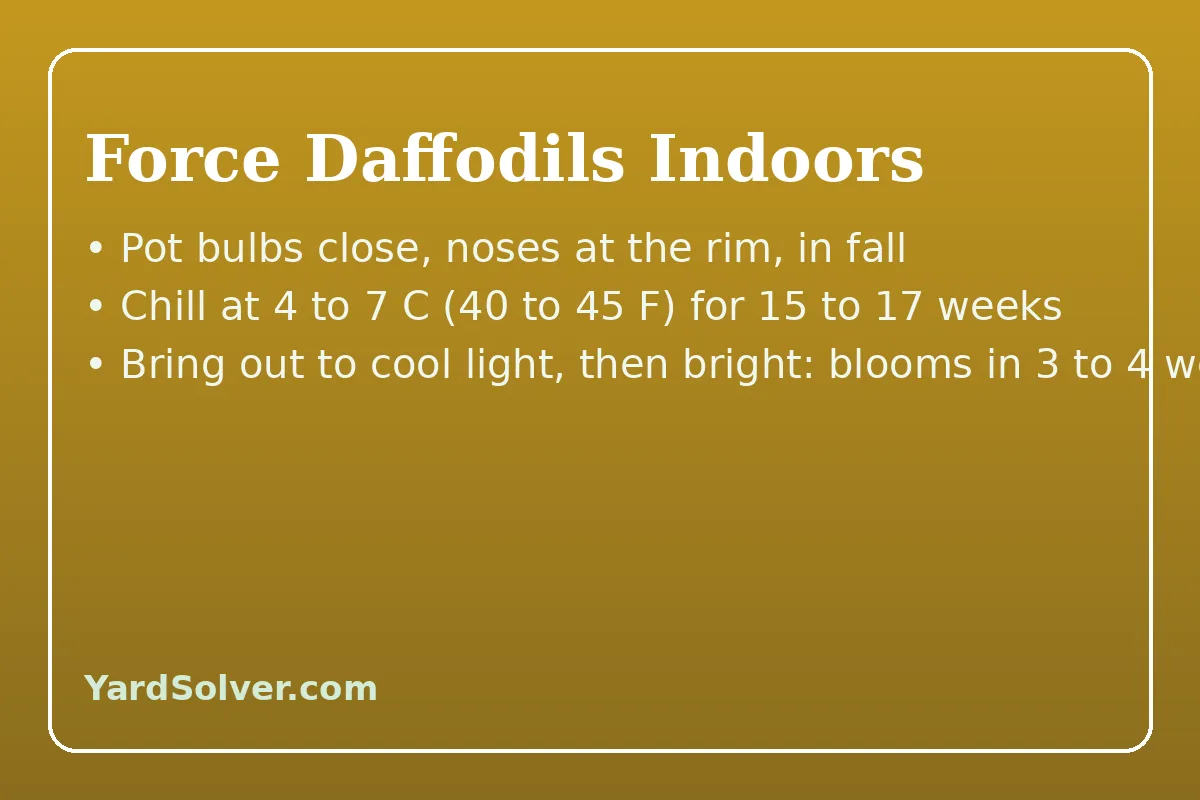
To force daffodils indoors, pot large, firm bulbs close together in a drained container of well-drained potting mix with their noses at or just above the rim, water them in, and hold them in complete darkness at 4–7 °C (40–45 °F) for 15–17 weeks, keeping the mix just damp; then bring the pots into a cool, dim spot at 10–16 °C (50–60 °F) until the shoots green up over four or five days, move them to bright light at 16–21 °C (60–70 °F), and expect flowers three to four weeks after the cold ends. Forcing is the gardener's time machine: the daffodil already contains its flower, formed inside the bulb the previous summer, and the only thing standing between a November pot and a February windowsill in bloom is a winter the bulb believes in. Iowa State University Extension's forcing guidance is reassuring about the cast list — of the spring bulbs, daffodils and hyacinths are usually the easiest to force — and this guide gives their full method: the backward count from the bloom date you want, bulb and pot selection, the potting geometry, the cold weeks and where a real household finds them, the two-stage bringing-out that prevents floppy, bleached growth, succession for a month of flowers, and the honest aftercare (a forced daffodil has spent itself, and this guide says what it can and cannot do next). It completes this site's forcing shelf alongside paperwhites, hyacinths and tulips — the daffodil asks the longest chill of the four and repays it with the sturdiest indoor flower of the set.
The short answer, on one card
Bulbs: the biggest and firmest available; one variety per pot; 3–5 standard bulbs (5–7 miniatures) in a 15 cm (6 in) pot. Potting: well-drained mix, at least 5 cm (2 in) beneath the bulbs, noses level with the rim, soil line 1–2.5 cm (½–1 in) below it, watered in thoroughly. Chilling: 15–17 weeks at 4–7 °C (40–45 °F), dark and just damp — refrigerator, root cellar, unheated garage or cold frame. Bringing out: 4–5 days cool and dim until shoots green, then bright light at room temperature. Bloom: 3–4 weeks after the cold. Timing: count back 18–21 weeks from the flowers you want — a mid-November potting blooms in late February.
Count backwards: the forcing calendar
| Stage | What happens | How long |
|---|---|---|
| Potting | Bulbs set in mix, watered in, labelled with variety and date | One November afternoon |
| Rooting and chilling | Roots fill the pot in the dark; the flower stem waits, formed, inside the bulb | 15-17 weeks at 4-7 C (40-45 F) |
| Greening up | Yellow shoots turn green in a cool, dim room | 4-5 days at 10-16 C (50-60 F) |
| Growing on | Leaves and stems extend in bright light; buds fatten and colour | About 2-3 weeks |
| Bloom | Flowers open; move the pot somewhere cool at night to stretch the show | Display of 1-2 weeks per pot |
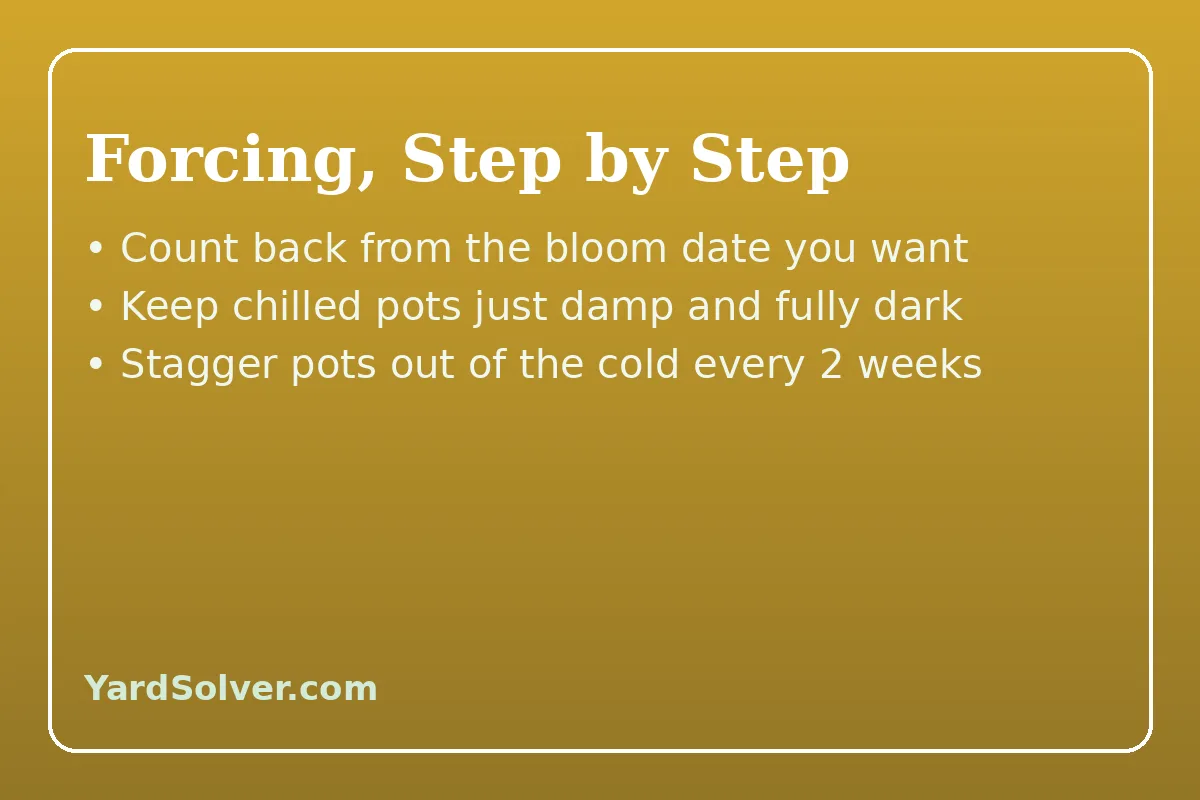
Penn State Extension frames forcing as a scheduling exercise before it is a gardening one: decide the date you want flowers, then count back the chilling period plus the growing-on period — 14 to 19 weeks in total for most bulbs, with daffodils at the long end of the range. Penn State's chilling table gives daffodils 15–17 weeks, the Old Farmer's Almanac's timetable agrees at 15–17 weeks of chill plus two to three weeks to bloom, and Iowa State's daffodil-specific answer gives 12–16 weeks of cold with flowering three to four weeks after removal. Read together, the honest planning number for a standard daffodil is this: pot by mid-November, and no arithmetic will give you Christmas flowers; what it gives you is better — flowers in the last, longest weeks of winter, when they are worth ten times their December price. Gardeners who want a season rather than a moment use Iowa State's succession device: pot several containers at once, chill them together, and bring them out of the cold one at a time, a fortnight apart, so the windowsill runs daffodils from February into April. Pre-chilled bulbs, sold ready-grown in garden centres in late winter, skip the cold entirely — they are the same trick performed by the grower — and are the honest shortcut for anyone who finds this guide in January with empty pots. The quotable fact of this guide is the direction of the work: forcing is not growing a flower — it is scheduling one, and the schedule is written in November, in the cold, by a gardener patient enough to plant a spring they will not see for four months.
Bulbs, pots and the potting geometry
Iowa State's requirements list is three items long — high-quality bulbs, a well-drained commercial potting mix, and suitable containers — and each repays a paragraph. Bulbs first: forcing spends the bulb's stored reserves, so the display is bought at the bulb bin. Choose the largest, firmest bulbs of a variety known to force well, reject anything soft, mouldy or basally damaged, and keep one variety to a pot, because varieties chilled together but bred to different clocks flower raggedly, a week apart, and spoil each other's show. Paperwhite narcissus are the famous exception that proves the family's rules — they need no chilling at all and are covered in their own guide — while the standard trumpet and large-cupped daffodils of the garden centres are the subjects here. Containers need drainage holes and modest depth: shallow bulb pans about 13 cm (5 in) deep are the traditional vessel, plastic or clay both serve, and Penn State specifies the geometry that makes them work — at least 5 cm (2 in) of mix beneath the bulbs for roots, and the tops of the bulbs even with the top of the pot. Iowa State's potting sequence runs: part-fill the container, set the bulbs on the mix, adjust the level until the bulb tops sit even with or slightly below the rim — typically three to five bulbs in a 15 cm (6 in) pot, five to seven for miniatures, close but not touching so one rotting bulb cannot spoil its neighbours — then add mix around them without burying the noses, which stay sticking above the surface, and leave the soil line 1–2.5 cm (½–1 in) below the rim for watering. No fertiliser is needed or wanted; as the Almanac puts it, the bulb arrives packed with all the nutrition this season's flower requires. Water thoroughly once, label with variety and date — February you will not remember November's varieties — and the pot is ready for winter.
The cold weeks: where a household finds 4 °C and darkness
The chilling is the step that intimidates beginners and the step that is actually simplest: the pots need a place that holds 4–7 °C (40–45 °F), stays dark, and can be visited weekly. Iowa State lists the classic sites — refrigerator, root cellar, or an outdoor trench — and Penn State adds the cool cellar and the garage, with the refrigerator flagged, in Illinois Extension's guidance as well, for one chemical hazard: ripening fruit gives off ethylene gas that damages the developing flowers, so chilled bulbs share their fridge with no fruit bowl, or live in a dedicated drinks fridge, a cold garage, or an unheated basement corner that holds its temperature. In genuinely cold climates the garage and trench carry the opposite risk — a hard freeze that splits pots and kills bulbs — so the coldest weeks may mean insulating the pots in a box of leaves or moving them to the coolest indoor spot; the target is a steady just-above-freezing, not a contest. Through the whole period the duties are two minutes a week: keep the mix just damp, never soggy and never dust-dry, topping up water when the surface dries, and confirm the dark. The visible progress is underneath and at the pot's base — roots emerge from the drainage holes within five or six weeks, the surest sign the system is working — and, late in the chill, pale yellow shoots nosing from the bulbs. Resist bringing a pot out early because the shoots look eager: the chill requirement is physiological, counted by the bulb in cold weeks, and a pot short-chilled by a fortnight flowers short, blind or not at all. When the count is honestly met, Iowa State's exit criteria are met too — yellow shoots begun, roots established — and the pot graduates to the light in two stages, which is the next section's whole subject.
Bringing out, blooming, and the honest aftercare
The commonest forcing failure is not in the cold but in the warmth: a pot carried straight from the dark fridge to a hot sunny sill grows bleached, floppy stems that keel over under their own flowers. The extension exit is staged, and Iowa State choreographs it precisely. First, a cool location at 10–16 °C (50–60 °F) receiving low to medium light, where the pot stays until the yellow shoots turn green — usually four or five days — because a shoot that greens before it stretches grows stocky and self-supporting. Then, and only then, the bright position at 16–21 °C (60–70 °F), where growth runs fast and flowering follows, on average, three to four weeks after the pot left the cold. Turn the pot a quarter daily — window growth leans hard toward the light — keep the mix evenly moist now that leaves are transpiring, and stake nothing: a well-exited pot stands on its own. When the buds colour, the display clock starts, and its length is set by temperature: a pot that spends its days in the bright room and its nights in a cool hall or porch will hold its flowers noticeably longer than one baked beside a register. Enjoy it without guilt, and then hear the honest aftercare plainly. A forced daffodil has spent the reserves the bulb spent a summer storing, and unlike the amaryllis of the reblooming guide, it will not perform again indoors next winter on any regime a home can offer. What it can do is retire honourably: keep the foliage growing in bright light until it yellows naturally, then plant the bulb out in the garden in spring or fall, where — given a year or two of leaf to rebuild — garden daffodils commonly resume their outdoor careers. What it cannot do is be re-chilled in April and expected to flower again by June. Forcing is a one-act performance bought with a bulb, and priced that way — a few dollars for February flowers — it remains the best bargain in the winter house.
Troubleshooting: blind pots, short stems and mould
Three disappointments account for nearly every failed forcing, and each has a diagnosis written before it has a cure. A pot that grows leaves but no flower stem — a blind pot — was almost always short-chilled, chilled too warm, or potted with immature bulbs: the flower was never set free by the cold, and no warmth afterwards can substitute for the weeks that were skipped. The remedy is next year's arithmetic, not this year's hope, though the foliage can still be grown on and the bulbs planted out to recover in the garden. Short, squat flowers that open down among the leaves tell the opposite story of timing: the pot came out of the cold and into heat and bright sun so fast that the flower raced ahead of its stem. The staged exit exists precisely against this — cool and dim first, bright second — and a pot caught early can still be slowed in a cooler room while its stems extend. Mould on the mix surface during chilling is a ventilation and moisture note rather than a catastrophe: the pots are being kept too wet in still air. Let the surface dry between waterings, keep the chill spot aired when you check the pots weekly, and remove any bulb that has gone soft, because one rotting bulb in a crowded pot is the only failure in this guide that spreads. Read that way, a forcing failure is never a mystery — it is a timetable entry that was shortened, a temperature that drifted, or a watering that lingered — and the notebook habit from starting a garden journal, with potting dates and chill weeks recorded, is what turns one winter's blind pot into the next winter's perfect count.
Keep going
Force the rest of the shelf with How to Force Paperwhites Indoors, How to Force Hyacinths Indoors and How to Force Tulips Indoors.
Sources
The daffodil method — high-quality bulbs, well-drained commercial potting mix, 3 to 5 bulbs in a 6-inch pot (5 to 7 miniatures) with the noses left above the mix and the soil line half an inch to an inch below the rim, chilling at 40 to 45 F for 12 to 16 weeks in darkness with regular watering, removal once yellow shoots have begun, four or five days in a cool 50 to 60 F low-light spot until the shoots green, then a bright 60 to 70 F position with flowering 3 to 4 weeks after the cold, and fresh pots brought out every 2 weeks for succession — follows Iowa State University Extension and Outreach, How Do You Force Daffodil Bulbs Indoors?. The scheduling framework — count back 14 to 19 weeks from the wanted bloom date, a chilling table giving daffodils 15 to 17 weeks, at least 2 inches of mix beneath the bulbs with their tops even with the pot's top, bulbs set about half a bulb-width apart, and chilling at 40 to 45 F in a refrigerator, cellar or garage — follows Penn State Extension, Forcing Flowering Bulbs for Indoor Beauty. The supporting details — potting from September to November, chilling at 35 to 45 F with the refrigerator warning about ripening fruit, and bloom 2 to 4 weeks after the cold — follow University of Illinois Extension, Bringing Spring Indoors: How to Force Bulbs to Bloom in Winter.
Questions people ask
How long do daffodils need to be chilled for forcing?
Plan on 15 to 17 weeks at 4-7 C (40-45 F) in darkness for standard varieties — the longest chill of the common forced bulbs. Some guidance allows 12 to 16 weeks; err long, because a short-chilled pot flowers short or blind, while an extra week of cold costs nothing.
When should I pot daffodils for February flowers?
Count back about 18 to 21 weeks — 15 to 17 weeks of chilling plus 3 to 4 weeks of growing on. For late-February blooms, pot in mid to late October or November. For a succession, pot several containers together and bring one out of the cold every two weeks.
Can I force daffodils in the refrigerator?
Yes — it is the most reliable cold most homes have. Keep the pots just damp and fully dark, and keep them away from ripening fruit, whose ethylene gas damages the developing flowers. A garage, root cellar or unheated basement holding 4-7 C (40-45 F) works as well, guarded against hard freezes.
Why are my forced daffodils floppy and pale?
They were brought out too fast. A pot moved straight from the cold into hot bright sun stretches bleached, weak stems. The fix is the staged exit: four or five days in a cool (10-16 C / 50-60 F), dim spot until the shoots turn green, then bright light. Green first, stretch second, and the pot stands on its own.
Do daffodils need fertiliser when forcing?
No. The bulb arrives packed with everything this season's flower needs — that is what a bulb is. Fertiliser in the pot only risks soft growth. Save feeding for bulbs you plant out in the garden afterwards, as their leaves rebuild the bulb for future springs.
Can a forced daffodil bloom again next year?
Not indoors — forcing spends the bulb's reserves in one performance. Let the foliage grow on until it yellows, then plant the bulb out in the garden, where after a rebuilding year or two it commonly returns to ordinary outdoor flowering. Buy fresh bulbs each fall for the indoor show.
Comments & ratings
No comments yet.
Be the first to share your experience.