
Guides · Seasonal projects · Published November 20, 2026 · By Faizan Ahmad
How to Make a Winter Wreath With Fresh Evergreens From the Garden
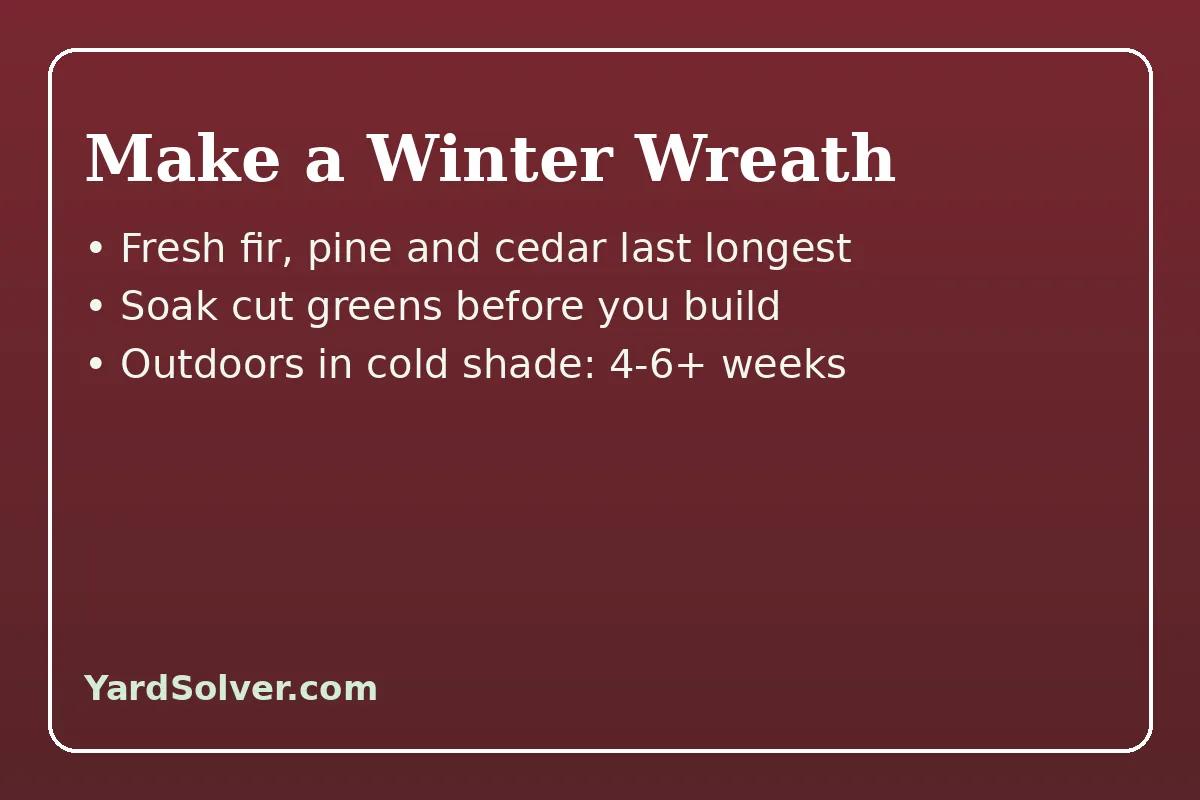
To make a winter wreath, wire small bundles of fresh evergreen cuttings — fir first, then pine and cedar — onto a reusable wire or grapevine frame, overlapping each bundle over the stems of the last, then soak the finished wreath before hanging it outside in cold shade, where it will stay fresh for four to six weeks or more. A homemade wreath costs almost nothing if your garden or a friendly tree lot supplies the greens, it uses the same prunings and trimmings that winter garden work already produces, and it composts completely in January. This guide covers which greens last and which shed, how to cut from garden shrubs without harming them, the bundle-and-wire build step by step, the soaking and misting routine that doubles a wreath's life, and how to hang one without damaging the door — for homes across Canada and the US, where a cold December is a wreath's best friend.
The short answer, on one card
Best greens: noble and Fraser fir hold longest, then balsam fir, white pine and cedar; blue spruce looks superb but is prickly to handle; Norway spruce sheds first — use it last or skip it. Cutting rule: a little from many plants, never a stripped branch from one; morning cuts, angled, straight into water. Build: bundles of 3–5 sprigs, wired firmly to the frame, every bundle overlapping the previous stems, all tips pointing the same way around the ring. Longevity: soak before hanging, hang outdoors in shade, mist lightly in dry spells — expect 4–6+ weeks outside in cold weather, about 2 weeks indoors. Cost: a frame you reuse for years and greens from the garden: close to zero.
Choose greens by staying power, not just looks
| Green | Staying power outdoors | Working notes |
|---|---|---|
| Noble fir, Fraser fir | Longest — the benchmark wreath greens | Stiff, well-spaced needles that barely shed; the tree-lot trimmings to ask for first |
| Balsam fir | Long, and the most fragrant | The classic Canadian wreath green; soft to handle |
| White pine | Long | Long, soft, flexible needles; the easiest green to wire and shape |
| Cedar (arborvitae) | Long | Flat, lacy sprays that fill gaps and layer beautifully under fir |
| Blue spruce | Good | Silver-blue colour, very sharp needles — wear gloves |
| Juniper, holly, boxwood | Good as accents | Berries and gloss for contrast; small quantities go far |
| Norway spruce | Shortest — sheds quickly | Use only for a wreath that must last a week, or leave it for mulch |
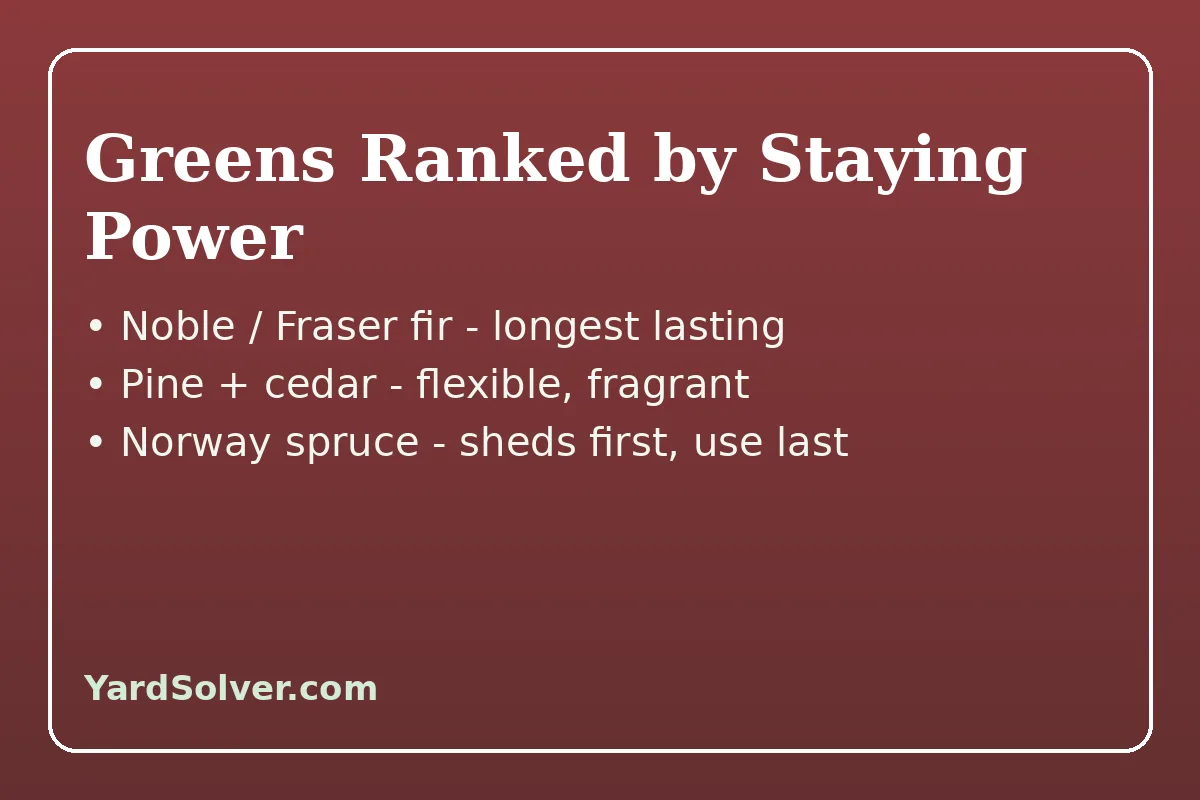
The ranking surprises people because the prettiest green at the lot is not always the longest-lived on the door. Fir needles attach individually and hold; spruce needles drop as the stem dries, Norway spruce fastest of all. Pine and cedar flex instead of snapping, which matters when you are bending bundles around a ring. The quotable rule: a wreath dies by drying, not by cold — choose greens that hold their water, then keep them cold. Everything after this section is just that sentence put into practice. If you are also choosing the tree itself this year, our cut Christmas tree guide ranks the same species by needle retention indoors, and its trimmings are your first wreath material.
Cut from the garden honestly
Garden shrubs can supply a wreath every year if you cut like a pruner, not a harvester. Take a few stems from many plants rather than a whole side from one, and never remove more than a small fraction of any single shrub — the working ceiling used by foragers is about a tenth of the plant. Cut in the morning when stems are fully hydrated, make clean angled cuts with bypass pruners, and put cut ends straight into a bucket of water. Evergreen shrubs tolerate light winter trimming well — you are mostly taking the tips that spring pruning would remove anyway — but skip any shrub that is stressed, newly planted, or already carrying winter damage, and never cut from a neighbour's hedge or a public park without permission. Tree lots are the other honest source: most will hand over the lower-branch trimmings from sold trees free or for a coin if you ask, and those cuttings are hours old and perfectly fresh. Pine cones, red twig dogwood stems, winterberry and dried seed heads gather on the same walk and cost nothing.
The build: bundles, wire and one direction
You need a frame — a wire wreath ring you will reuse for years, or a grapevine base — plus a spool of green floral wire, pruners and gloves. Cut your greens into sprigs 15–20 cm (6–8 in) long and sort them into piles by type. Anchor the wire to the frame, then make your first bundle: 3–5 sprigs layered with the longest at the back, stems aligned. Lay the bundle on the frame and wrap the wire around its stems three times, pulling firmly. Lay the next bundle so its tips cover the wired stems of the first, wrap again, and continue around the ring with every bundle pointing the same way — that single-direction overlap is what makes a wreath look full and professional instead of patchy. Work accents in as you go: a sprig of juniper or holly in every third or fourth bundle, cones wired in by their bottom scales at the end. When you close the ring, tuck the last bundle's tips under the first bundle's foliage, wire off, and fluff. A standard door wreath takes 12–18 bundles and under an hour once the greens are cut. The same greens, pushed into moist soil instead of wired, build the larger display in How to Make Winter Porch Pots — make both in one session and the whole front step is done.
Soak it, hang it cold, mist it lightly
Care decides whether the wreath lasts two weeks or six. Before decorating or hanging, hydrate it: submerge the finished wreath in a tub of water for several hours — wreath-keepers who soak greenery for up to a full 24 hours before building report the longest life — or at minimum soak all the cut ends thoroughly, then let it drip dry. Hang it outdoors if you possibly can: cold air is preservative, and a sheltered, shaded door under a porch roof is the ideal spot, out of direct sun and drying wind. Indoors, a fresh wreath lives about two weeks and fades fastest near heating vents, fireplaces and sunny glass — the same heat rules as the tree, covered in Living Christmas Tree Care for potted alternatives. Mist lightly every few days in dry weather, and after a mild spell; an anti-desiccant spray at hanging slows moisture loss further, the same product used against winter burn on evergreens. Hang it with an over-door hook or a ribbon from a nail — never a suction cup on cold glass, which lets go. In January, strip the wire and cones for next year and compost the greens: a wreath that returns to the garden is the whole point of making one.
Troubleshooting: shedding, browning and wind
Three problems account for nearly every disappointing wreath, and all three are moisture problems in disguise. Shedding in the first week means the greens were already dry when built — usually spruce cut too long before building, or cuttings that sat in a warm room. There is no rehydrating a wired wreath back to freshness; soak what you can, mist daily, and next year build within a day or two of cutting and keep the work-in-progress in a cool garage, not the kitchen. Browning from the inside out means heat: a wreath over a storm door that traps sun, or indoors above a vent, cooks slowly even while the outside needles look green. Move it to shade or outdoors and it will hold at its current state rather than worsening. Gaps and a lopsided ring are build problems, fixed at the bench, not on the door: bundles that vary in size, or tips that change direction, read as holes from two metres away. Rebuild the thin section with two extra bundles rather than stuffing single sprigs into a finished wreath, which always shows. Finally, wind: on an exposed door, wire the wreath to its hook as well as hanging it, and add a second tie at the bottom — a wreath that swings and slaps the door sheds needles with every gust, however fresh it started.
Variations from the same armful of greens
Once the base method is in your hands, the same cuttings make the whole set. A swag — one long bundle tied at the top and hung vertically — takes ten minutes and suits a gate, lamp post or mailbox. A table ring built on the same frame but laid flat, with a storm lantern or three pillar candles in the centre (in glass, never near the foliage with a live flame), carries the greens indoors for a single evening without the two-week indoor fade, because it goes back outside afterwards. Mini wreaths from a small frame or a bent coat-hanger circle use the offcuts and sprigs too short for the main ring, and hang on cupboard knobs, chair backs and the necks of bottles as gifts. Gardeners with herbs still standing can wire in rosemary and bay for scent, and dried orange slices, cinnamon sticks and saved seed heads from the fall garden give the natural accents that cost nothing and compost with the rest. Build them all in one session while the greens are fresh and the wire is out — the marginal wreath costs minutes, and December callers notice a house whose door, gate and table all match.
Keep going
Pair the wreath with How to Make Winter Porch Pots for the full front-step display, choose the tree with How to Choose and Care for a Cut Christmas Tree, keep it watered with How Much Water Does a Christmas Tree Need?, and finish the month on the December Garden Checklist.
Sources
The longevity care routine — soak foliage for a full 24 hours before building, display outdoors in a cool sheltered spot, spritz daily or every other day indoors, and the fir/spruce/pine species guidance — follows How to Keep a Wreath Fresh (Gardening Know How). The overnight soak, freshness tests (shake and scent), covered-porch placement and eight-week outdoor results follow 4 Things That Keep Holiday Wreaths and Garlands Green for 8 Weeks (Garden Betty). Bundle sizes, base options and the take-no-more-than-a-small-fraction foraging rule follow DIY Christmas Wreath: Foraged Evergreen and Natural Styles (The Rike).
Questions people ask
How long does a fresh evergreen wreath last?
Outdoors in cold, shaded conditions, a well-made fir, pine or cedar wreath lasts four to six weeks, and longer in deep cold under a porch roof. Indoors it lasts about two weeks, less near heating vents or in direct sun. Soaking the wreath before hanging and misting it lightly in dry spells extends its life at either location.
What are the best greens for a winter wreath?
Noble and Fraser fir hold their needles longest, followed by balsam fir, white pine and cedar. Blue spruce adds silver-blue colour but is sharp to handle. Norway spruce sheds the fastest and is the one to avoid for a wreath that must last the season.
Can I cut wreath greens from my own shrubs?
Yes, with pruning discipline: take a few stems from many plants, no more than about a tenth of any single shrub, cut in the morning with clean angled cuts, and put the ends straight into water. Skip stressed or newly planted shrubs, and never cut on someone else's property without permission.
Do you need to soak a wreath before hanging it?
It is the single most useful step. Submerge the finished wreath, or at least all its cut ends, in water for several hours — up to 24 — before hanging. Cut evergreens dry out from the cut end; a wreath that starts fully hydrated can last twice as long as one hung dry.
How do you hang a wreath without damaging the door?
Use an over-door wreath hook sized to your door, or a wide ribbon looped over the top of the door and secured inside. Avoid adhesive hooks and suction cups outdoors in cold weather — both let go without warning and drop the wreath.
What do you do with a fresh wreath in January?
Strip and keep the frame, wire, cones and any non-organic decorations for next year, and compost the greens or lay them as winter mulch on a perennial bed. Nothing from a homemade fresh wreath needs to go to landfill.
Comments & ratings
No comments yet.
Be the first to share your experience.