
Guides · Winter jobs · Published November 20, 2026 · By Faizan Ahmad
How to Remove Snow From Shrubs Safely: Brush Up, Never Beat It Off
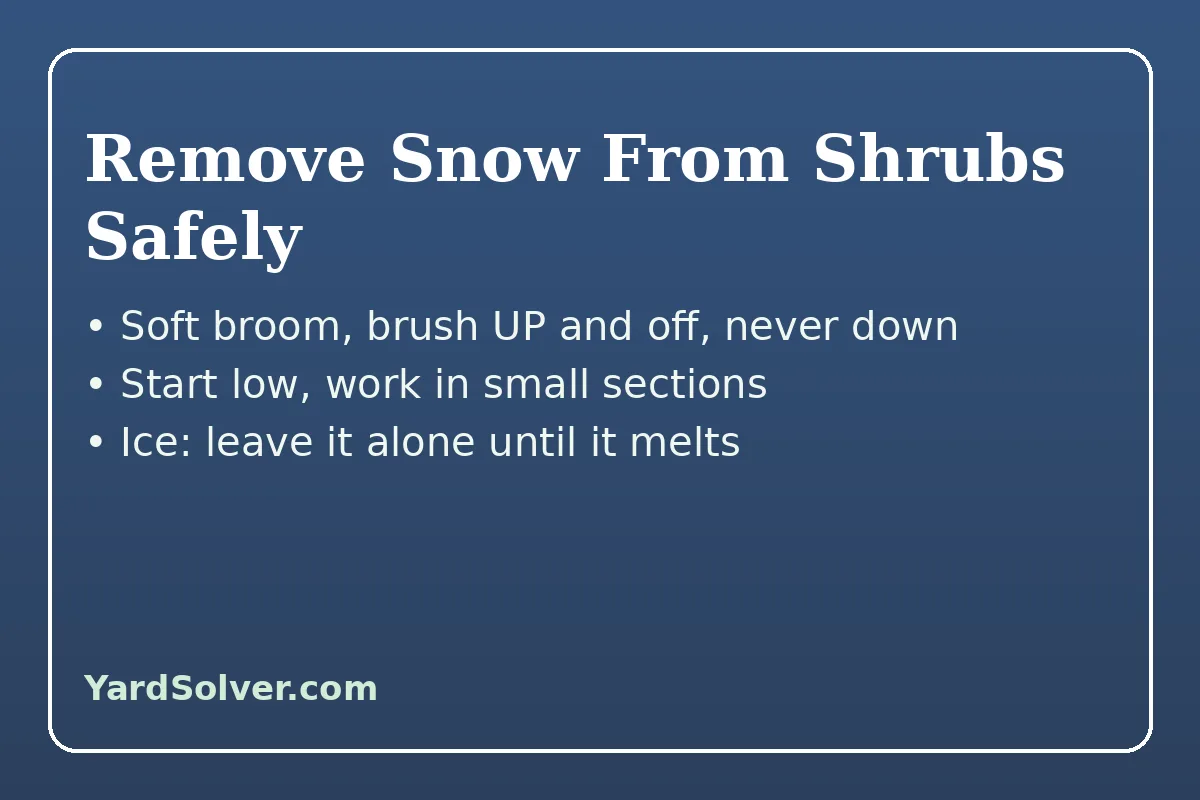
To remove snow from shrubs safely, brush loose snow gently upward and off the branches with a soft broom, starting from the lower branches and working up in small sections, supporting any bent branch from below — and if the load is ice or frozen crust rather than loose snow, do nothing at all and let it melt. Every winter, well-meaning gardeners snap more branches with shovels, rakes and vigorous shaking than the storms themselves break, because frozen wood is brittle wood and a downward sweep adds the snow's weight to a branch already carrying it. The difference between a shrub that springs back in spring and one that splits down the middle in January is usually ten careful minutes with the right tool, in the right direction. This guide separates the three loads — dry snow, wet snow and ice — because each demands a different response, names the shrubs that split first, and gives the before-the-storm tying routine that prevents most of the damage outright, for gardens across Canada and the US snow belt.
The short answer, on one card
Tool: a soft broom or a gloved hand — never a shovel, rake or beating stick. Direction: up and off, lifting snow off the branch; sweeping down pushes the load onto the wood beneath. Order: lower branches first, small sections, reassess after each pass. Support: one hand or the broom head under a bent branch while the other clears it. Ice: leave it entirely alone — no knocking, no chipping, no hot water. Prevention: loosely tie upright evergreens before storms and keep shovelled driveway snow off the shrubs.
Read the load first: snow is three different problems
| The load | What it does to the shrub | Your response |
|---|---|---|
| Light, dry powder | Sits on top; modest weight; sheds easily | Brush off promptly with upward sweeps, or leave — it often blows or slides off itself |
| Wet, heavy snow | The real branch-breaker: dense, adhesive, bends stems outward and down | Remove the same day, in small supported sections, starting low |
| Roof-slide and plough snow | A dumped load, far heavier than fallen snow, often full of grit and salt | Prevent by siting and A-frames; clear gently by hand in layers, never by levering |
| Ice and frozen crust | Locks branches in a rigid cast; the load is the least of it — the brittleness is the danger | Do nothing. Wait for thaw. Every extension service gives this same answer |
The interpretation step matters because the wrong response converts a load a shrub was surviving into the force that breaks it. Iowa State and Kansas State extension guidance, summarised in current snow-care advice, converge on the same line: knocking at ice or frozen snow breaks branches and strips foliage, and NC State's version is the simplest — if snow is frozen onto the branches and will not come off easily, let it melt. Wet snow deserves urgency for the opposite reason: it keeps accumulating, it gains weight as temperatures hover near freezing, and a multi-stemmed evergreen bent outward at midnight may be a split evergreen by morning. Dry powder, by contrast, rarely harms anything and mostly needs removing from shrubs under eaves, where the next load — the roof slide — lands on top of it. Hence the quotable rule of this guide: snow is a weight problem you can help with; ice is a patience problem you cannot.
The shrubs that split first
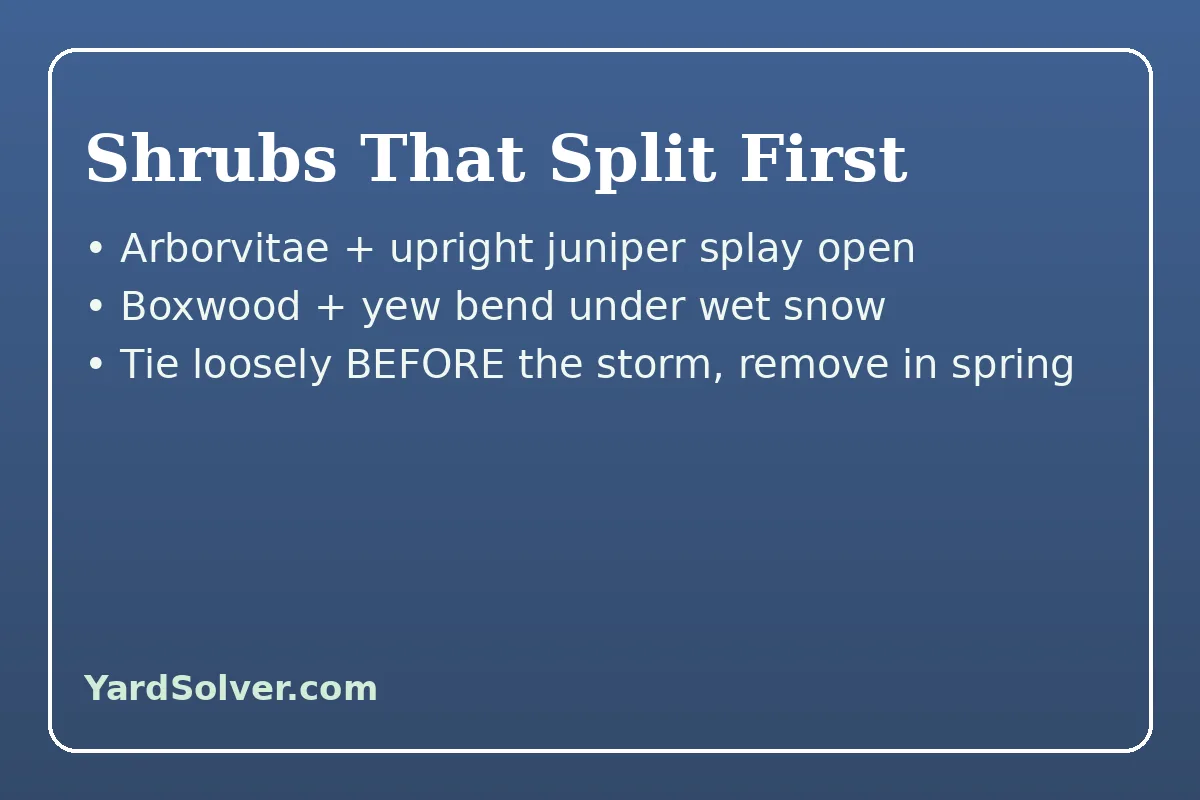
University of Minnesota Extension lists upright evergreens such as arborvitae and juniper among the plants most likely to suffer snow and ice damage, and the pattern holds across northern gardens. Multi-stemmed arborvitae and upright junipers open like a book under a column of wet snow, the stems prised apart at weak crotches until they crack at the base — and stems split away from the centre do not always grow back together, leaving a permanent hole in the hedge. Boxwood and yew, dense and fine-branched, catch and hold snow across their whole top surface and bend as one heavy mat. Spruce with two competing leaders stores snow in the crotch between them, which acts as a wedge. Loose, multi-stemmed deciduous shrubs — hydrangea, spirea, lilac — catch snow across many small forks and usually flex rather than split, though an ice load changes that arithmetic too. Knowing which of your shrubs is which type tells you where your ten minutes go first after a storm, and which plants earn the tying treatment in the prevention section below. The winter-damage family is larger than snow alone: the same walk should check for the browsing and bark damage covered in How to Protect Trees and Shrubs From Winter Animal Damage and the browning addressed in How to Prevent Winter Burn on Evergreens.
The technique: support, lift, small sections
Work from outside the plant, on ground you have checked is safe to stand on — never under a loaded limb, a roof edge shedding snow, or utility lines. Take the soft broom and begin at the lower branches, because clearing the top first dumps its snow onto the branches beneath, doubling the load on the wood least able to bear it; NC State's guidance to start low and Iowa State's instruction to brush loose snow upward are the same principle seen from two sides. Move in small zones: support the branch from below with the broom head or your free gloved hand, sweep the snow up and off in short, light strokes, then pause and watch the branch — a stem released from part of its load often springs partway back, changing the angle and tension of everything still above it. Keep the broom moving with the branch rather than against it, and stop at the first sound or feel of resistance: cracking, creaking or a limb that pushes back is information, not a challenge. A gentle shake is acceptable on a small, flexible deciduous shrub; on a frozen evergreen, shaking is how branches leave the plant. And never try to stand a bent shrub back upright by force — bent is not broken, frozen wood forced straight is how bent becomes broken, and most shrubs given until spring recover their shape on their own.
Before the next storm: tie, screen and site
Prevention is cheaper than rescue, and it is mostly one technique: drawing vulnerable stems gently together so snow slides off a single cone instead of wedging into separate stems. On a dry day before the storm, spiral soft twine, cloth strips or wide tree tape loosely up an arborvitae, upright juniper or columnar yew, starting near the base and finishing two-thirds to three-quarters of the way up, holding the stems together without squeezing them — UMN Extension's guidance for tying leaders above weak crotches uses the same two-thirds measure. Every tie comes off in early spring without exception; a tie forgotten into the growing season girdles the stems it saved. Shrubs planted under rooflines deserve a wooden A-frame or a slanted board that sheds the roof slide past the plant rather than onto it, and the cheapest prevention of all is a rule for whoever shovels: driveway and walk snow — heavier, dirtier and often salted compared with fallen snow — never gets piled on shrubs and hedges, which is also the household habit behind How to Prevent Salt Damage. A burlap screen on the windward side, built as part of the winter protection in How to Protect Young Trees in Winter, breaks the wind that packs snow into branches in exposed sites.
After the thaw: inspect first, prune second
When the load finally melts, walk the shrubs before you touch the pruners. Look for split branches still hanging in the canopy, cracks opening at branch unions, stems bent to the ground and tips snapped on evergreens. Prune only once the wood has thawed — cold wood shatters under tools and wounds seal poorly — and cut broken branches cleanly back to a lateral branch or the branch collar, the same clean-cut discipline as the seasonal work in How to Prune Fruit Trees in Winter. A shrub splayed by the storm but unbroken gets coaxed, not forced: draw the stems loosely together with soft ties for one growing season and let new growth knit the shape back. Anything cracked, hanging or leaning over a path, a roof or a power line is not a broom job at all — that is the arborist's list, and it jumps the queue ahead of every cosmetic repair. Finish the storm round by adding the date, the load type and what you did to the record habit in How to Start a Garden Journal: the shrubs that split this winter are the shrubs that get tied first next November, and that sentence is only true if somebody wrote it down. Fold the whole check into the December Garden Checklist and the January round that follows it, and snow becomes what it should be in a northern garden — weather, not damage.
Special cases: hedges, roof lines and the second storm
Three situations bend the general rules. Long hedges — cedar and yew especially — cannot be brushed stem by stem, and do not need to be: work along the face with the broom in long, upward strokes, clearing the top surface where the load actually sits, and accept the snow that remains packed harmlessly inside the foliage. A hedge that splays every winter despite tying is telling you its stems have already separated at the base; the lasting fix is a discreet internal frame or cable fitted in spring, not tighter twine. Shrubs under rooflines face the worst load in the garden, because a roof slide arrives all at once and can weigh more than the shrub. If a prized plant sits in the slide path, the A-frame is not optional decoration but the main defence, and after a slide the excavation is done by hand, in layers, from the outside in — levering a buried shrub out with a shovel trades snow damage for root and crown damage in a single motion. The second storm is the one that breaks shrubs, because it lands on plants still carrying the first storm's bent shape and, often, a crust of ice from the melt between. Clear what loose snow you safely can before it arrives, re-check ties that the first storm loosened, and give the ice rule its full force: a shrub carrying ice into a second snowfall is a shrub to watch from the window, not to rescue with a broom. Patience through the second storm, followed by a careful thaw inspection, saves more plants than any heroic mid-storm effort — the garden's winter motto could fairly be that the plants are tougher than they look, and the gardener's tools are more dangerous than the weather.
A note on salt, grit and the walkway shrubs
The shrubs along the front walk live the hardest winter of any in the garden, because they receive snow from three directions at once: the sky, the shovel and the road. Shovelled walk snow carries the salt and grit spread on the path itself, and every pass of the shovel adds another layer, so by February a walkway boxwood can sit inside a frozen block of salted snow that no fallen snow would ever have built. The defence is partly technique — throw walk snow away from the planting, never onto it — and partly the barrier and rinsing routine in our salt guide, applied to these shrubs first when spring comes. When you clear a walkway shrub after a storm, work it before the others and clear it fully, top and faces, because its next load is already being shovelled toward it. And when you choose replacements for a walk that eats shrubs, choose from the salt-tolerant end of the list and set them a few centimetres further back from the edge than looks necessary in June. The walk will thank you every winter, in the only currency it deals in: shrubs that are still the shape you planted.
Keep going
Work the whole winter-damage round together: How to Protect Trees and Shrubs From Winter Animal Damage, How to Prevent Winter Burn on Evergreens, How to Prevent Salt Damage and How to Protect Young Trees in Winter.
Sources
The read-the-load-first method, the soft-broom technique of supporting the branch from below and removing loose snow in small passes, and the warnings — drawn from Iowa State, Kansas State and NC State extension guidance — that knocking at ice or frozen snow breaks branches and that frozen-on snow should simply be left to melt follow Remove Heavy Snow From Shrubs Safely (Flora & Field). The sweep-up-not-down rule, leave-ice-alone rule, the warning against standing bent trees back up and against piling shovelled snow on shrubs, and the pre-storm tying of cedars follow Snow on Trees: What To Do in Edmonton (Edmonton Arborist, Canada). The University of Minnesota Extension identification of upright arborvitae and juniper as the shrubs most prone to snow and ice damage, and the two-thirds tying measure, follow Before Heavy Snow, Tie Up or Wrap These Shrubs (Lawn Craft Supply).
Questions people ask
Should you knock snow off shrubs after a storm?
Loose snow, yes — gently, with a soft broom, sweeping upward and off the branches. Ice and frozen crust, never: knocking at frozen loads breaks brittle branches and strips foliage, and extension guidance is unanimous that frozen-on snow should be left to melt on its own.
Why brush snow upward instead of sweeping it down?
A downward sweep pushes the snow's weight onto the branch and the branches below it, adding load to wood that is already bent and frozen brittle. Brushing upward lifts the weight off the branch, and starting with the lower branches prevents cleared snow from landing on wood still carrying its own load.
Which shrubs are most likely to be damaged by snow?
Upright, multi-stemmed evergreens: arborvitae and upright juniper splay open and split at the base, a risk University of Minnesota Extension flags specifically. Boxwood and yew bend under mats of wet snow, and spruce with two leaders traps snow in the crotch, which wedges the leaders apart.
How do you protect shrubs from snow before a storm?
Tie vulnerable upright evergreens loosely with soft twine in a spiral up to about two-thirds of their height, so snow sheds off a single cone instead of wedging stems apart. Shield shrubs under rooflines with a wooden A-frame, never pile shovelled snow on them, and remove every tie in early spring.
A shrub is bent flat under snow but not broken. What should I do?
Nothing, for now. Bent is not broken, and forcing frozen wood upright is how it snaps. Clear loose snow gently if you can do so without moving the stems, then wait: most shrubs recover their shape as the load melts and spring growth resumes. Loose support ties for one season help a splayed evergreen knit back together.
When should snow damage be pruned?
After the wood has thawed. Cold wood shatters under tools and wounds seal poorly, so wait for a thaw, then cut broken branches cleanly back to a lateral branch or the branch collar. Cracked or hanging limbs over paths, roofs or power lines are a job for an arborist, not a homeowner with a broom.
Comments & ratings
No comments yet.
Be the first to share your experience.